• Welcome to my Observations

    Online observations of public relations, marketing, advertising and social media; the occasional frivolity; and The Rundown show notes. Jump in, the water's fine.

    Please Note: Everything posted on this blog is my personal opinion and does not necessarily represent the views of my employer or its constituents.

  • My Pinterest

  • LinkedIn

    View Luke Armour's profile on LinkedIn
  • Archives

  • Categories

  • The Rundown Podcast Live

    The Rundown

  • RSS Media Bullseye

    • An error has occurred; the feed is probably down. Try again later.
  • Creative Commons

  • The Show Player

  • Pages

  • February 2026
    S M T W T F S
    1234567
    891011121314
    15161718192021
    22232425262728
  • Meta

Paper Forts!

Up to my neck, God I love that phrase, because sometimes its just so descriptive! I know I have been away. Currently, I am working on my Master’s project on nonprofit blogs and am surrounded by stacks of paper, print outs, and books. I could make a nice fort for myself. After, scouring the blogosphere for nonprofit blogs here is what I have found. When I am all finished and screaming from mountain tops and doing a little dance, I will post my project to a Web site.

  • Approximately 172 nonprofit blogs exist and 112 nonprofit organizations are blogging. I say approximately because this number changes. Some nonprofits have several blogs, like Greenpeace and some are archived. I did not account for blogs written about nonprofit organizations.
  • Overall, blogs are used for raising awareness about the organization its program, mission, and goals, to provide information as in the form of an online newsroom or on a specific issue, and to converse with constituents.
  • The type of nonprofits blogging run the gamut from environmental and social advocacy organizations to associations and museums. All have found some benefit to the medium.

The exciting thing about my project is that I will also be setting up a blog template for a nonprofit in Northeast Ohio. Time for me to get back to work. As Arnold Schwarzenegger says, “I’ll be back.”

Things We Used to Do on Grass

Paull YoungGrass Pusher

Not Quite the Tylenol Team

This article from the NY Times shows just how much things have changed since the Tylenol incident from the 80s. I don’t have all the facts, but when I read things like this:

A spokesman for Johnson & Johnson, Mark Wolfe, said: “We disagree with the outcome of this trial. We are evaluating our legal options.”

it makes me realize that this isn’t the same team that worked on the crises from yesteryear. Before Crisis PR, before worlds of spin, and flacks doing damage control, Johnson and Johnson relied on their creed to help them weather a horrific tragedy. Now, things seem different, more litigious, less consumer friendly.

Johnson & Johnson’s lawyers contend that Ms. Thompson did not die of a fentanyl overdose and that there was no evidence her patch leaked. They attributed her death to “natural causes,” like heart problems.

I’m interested in seeing how this all pans out. Will this turn out to be a case of a company protecting itself from lawyers, doctors, and ignorant consumers – or – will this turn out to be a rather large blotch on the Johnson and Johnson name?

Advertorial – acceptable or devil’s penmanship?

Is it pay-for-play, unethical, okay, or acceptable only under certain circumstances? I took a poll through the Bulldog Reporter this week and took a snap of the results. Sixty-eight percent of those who responded (no mention of how many people had weighed in) think pay-for-play marketing should never happen. I note that it includes ethical issues for both journalism and PR. Nice touch. Twenty percent indicated it would be done under certain circumstances. But who has the definition of pay-for-play? Lots of wiggle room, I’d imagine. I mean, c’mon Clinton taught us we can legally stretch the definition of any word.

But advertorials? Who would argue that advertorials are unethical? I’m a big fan of advertorials used in certain circumstances. They’re tools of communication just like blogs or brochures. In some situations, it’s the best way to get the message out. Didn’t Johnson & Johnson put out advertorials during their mid-80s poison crisis? It was a way for them to get their story out in the days before the web.

But this NYT article from Maria Aspan indicates the blurry line some people are walking. The article details how the writer of an advertorial was paid for it, but also listed as a contributing editor in the publication. Not to mention the “this is a paid advertisement” was barely visible to the naked eye.

Kelly McBride, ethics group leader at the Poynter Institute, a journalism organization [said] “As a member of the audience, how do I know where his loyalties are when I see his byline on something else?”

Purposefully deceptive? How does this compare to ghost writing? It doesn’t, if you ask me. But when you’re a contributing writer of a rag and are also paid to write ads for the same – that does sound a bit odd. As PR pros we’re bound to run into pesky predicaments every once in a while. Part of our jobs is to write.

I mean, right there in the PRSA Code of Ethics it clearly states:

A member shall:
• Be honest and accurate in all communications.
• Act promptly to correct erroneous communications for which the
member is responsible.
• Investigate the truthfulness and accuracy of information released
on behalf of those represented.
• Reveal the sponsors for causes and interests represented.
• Disclose financial interest (such as stock ownership) in a client’s
organization.
• Avoid deceptive practices.

I mean, I’m just telling you what it says. But so very few of the people who engage in PR practices are members of PRSA, IABC, or CIPR. So, there’s a loop hole.

To me, this whole thing goes back to definitions. PR is so inaccurately defined so often. PR is practiced by people who don’t understand it fully. PR is not solely publicity, but I’d wager most of the self-proclaimed PR pros out there do only that. PR is not just getting coverage for clients at any cost. Because there is a cost. And people are watching. Would there be a PR Watch organization if we stuck to a code of ethics?

Update: Robert French has a nice little discussion about online pay for play here.

Friday Frivolity

Sound smarter: Stop saying "like" 

For PR pros, that's a quick and easy way not to sound like an idiot. From Boing Boing:

This billboard advises you to stop using the word "like" as punctuation, on behalf of something called the Academy of Linguistic Awareness.

You can view another billboard of the Academy of Linguistic Awareness here.

As a former college instructor I can't tell you how true it is that using "like" is the equivalent of saying "never take me seriously and have a terribly difficult time following my ragged train of thought" or, simply, "I'm, like, an idiot." 

PR dissed by journalism – again

This is old news to many (April), but it just re-read it again on the Bulldog Reporter this week. It touched a nerve. Bob Zelnick, a former ABC news correspondent and head of BU's journalism department stepped down from his post because he recognizes his inadequacies as an administrator. Good on ya, man. It's good to recognize one's strengths and weaknesses. He will instead become a professor of national and international affairs. I admire that. What I found surprising is what he said when he left.

For example, the headline from the Bulldog: Boston University’s Outgoing Journalism Program Chairman Snubs Communications Dept.—Says PR/Advertising and Journalism Should Be “Adversaries,” Not Interdepartmental “Cousins” like, ouch, man.

Headline from the Boston Globe article: Debate roils BU department (By Sarah Schweitzer and Marcella Bombardieri) Well, at least you can tell which article came from a PR source 😉 The part of this article that I like best is the quote from Bob.

"Zelnick said the journalism program has become increasingly competitive with the best in the country, but 'we will never get a Grade A, first-rate, nationally recognized journalist to lead this department as long as it's linked' to mass communication."

It's funny he should say that. As a recent graduate, I've been thinking for years that communication studies have been held back by the placement of the departments in colleges or schools such as Journalism, Fine and Applied Arts, or Stuff No One Cares About in universities across the nation.

I just read Everett M. Rogers' book "History of Communication Study" and I at least now have an understanding of why things are that way in colleges today (you should read it if you like dry, lengthy historical books. Good info, though). But I agree with Zelnik, the departments could be separated, but I think for completely different reasons. Communication study has developed immensely in the last 40 years and deserves a home of its own. Students and communication fields would benefit greatly, especially PR. I applaud those universities and colleges across the world with stellar PR departments, but often students end up at schools they can afford or geographically get to – not often the best schools for all that learnin'.

Any thoughts or is this a tired subject? 

Sorry, been busy

First of all I just wanted to apologize for my extended absence. After graduation, life was just a whirlwind of activity. So much to do. First there was going on the obligatory "yippee, I just graduated" road trip followed by the continued job search followed by getting a job followed by going to a really great weekend adult hockey camp followed by starting a new job followed by watching the Stanley Cup Playoffs and right into shopping for a new house. So, yeah, been busy, sorry about that. Beth? Uh, can't tell you what's her excuse. So there will be some changes as I fit all of these things together. Thanks for hanging with me here. I now return you back to your regularly scheduled programming.

See Value in Letting Go

This article from the New York Times (By STUART ELLIOTT Published: June 13, 2006) put a smile on my face. Letting agencies make strategic decisions for the company? Sounds good to me. I mean, agencies are supposed to know their stuff, so why not let them go about doing it?

Last year when I was in England, CEO of Edelman London, Stuart Smith, gave me an analogy that I've used often since. He referred to agency work as having both "arms and legs" and "brains" that are offered as part of the services. Sometimes organizations just need help with the tasks at hand, writing, creating, building things – that's the "arms and legs." The "brains" come in when an organization needs help with the strategic planning. Some companies need one or the other, some utilize both. But it has always seemed to me that a smart thing to do would be to hire an agency with proven strengths and let it do its job. Allow it to develop strategies with you, not just do things you tell them to. I mean, I would personally never hire a contractor to remodel my kitchen based solely on my design…I mean, I know nothing about…uh, buildin' stuff. That said, I would never let my contractor rebuild my kitchen without my input. I would utilize both the contractor's brain and her arms and legs to get the job done.

From the article:

One change is meant to help General Mills adapt to the new-media landscape as it tries to reach consumers using nontraditional approaches like the Internet, e-mail marketing and branded entertainment.

"The old media are alive and well, but the new media are in a very steep growth curve," said Jeffrey Merrihue, chief executive at Accenture Marketing Sciences in London, a unit of Accenture.

"You need to plan to take advantage of the opportunities and prepare for a future when the new media are more and more important," Mr. Merrihue said. 

This article shows just another way in which new media channels have allowed good companies to find ways to use them. They might not understand the medium completely, but there are those who do. And letting those people do what they know how to do is a great start for both the organization and the representative agency.

The Blogger Dichotomy

This is a little late, but I've been mulling this topic over for a while.

Spawned by this this post by Wagstaff, I've been wanting to post something about this since I read it as well as add some of my own thoughts on the subject. Wagstaff goes into detail about PR people and bloggers, it's an interesting read. Be sure to read the transcript of Richard Edelman's Q & A linked from Wagstaff at Weinberger's site as well as Richard's own commentary on the subject. There are some tips that you can sort through.

Bloggers. Bloggers are people, too. Sometimes they are rather influential people, but they're people. How does one, as a blogger, balance life and blogging? Mike Sacks wrote an interesting post recently about how disappointed he is with PR bloggers the other day. His point was this: Write about PR if you're a PR blogger. I mostly agreed with him. But nobody is just a PR blogger. These people are also tech geeks, PR pros, fathers, sisters, managers, idealists, realists and daughters. You have to sort through what is out there and find things that resonate with you. (Read the comments on Mike's post, too, they're interesting. Oh, also, Mike doesn't like it when bloggers write about blogging, so he's probably rolling his eyes about this, too. 😉 I can't help it.)

We're used to journalists writing about their beats. A journalist rarely mentions in a post about political unrest in Kerplakistan that his daughter is teething and isn't that cute. Would I read a magazine that didn't stay on topic? Probably not. But blogging is different, blogging is people, blogging is all the person at least some of the time. That's what makes it so cool.

But the balance is hard to attain. Where does one put the fulcrum? Am I a PR blogger or a person? Am I a professional or a guy with a chip on his shoulder? Am I a representative of my agency or a solitary entity. All of the above I guess. I suppose we all find our groove and fit into it, as both a blog reader and a blog writer. It is incredibly hard for me to unsubscribe to feeds I've been reading since I found the blogosphere even though I rarely find anything of value to me in them. Why? Because I might miss something. And it's also hard for me to write about things that interest me if I feel my readers might find them off topic, but it's who I am.

We should all really be grateful that I'm not blogging about the Stanley Cup Playoffs (I probably would be, except that I don't get OLN).

So, blogging is an anomaly that we're not really quite used to merging with the "real world" yet, there's clearly a dichotomy between who we are and who we present ourselves to be. And it's something we need to be ready for if we are to work with bloggers to help spread our messages. I'm up for the challenge.

Friday Frivolity

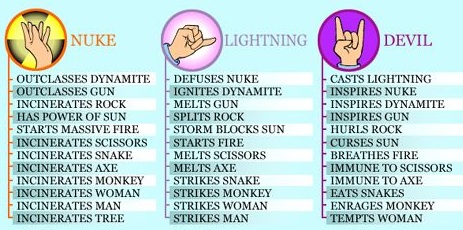
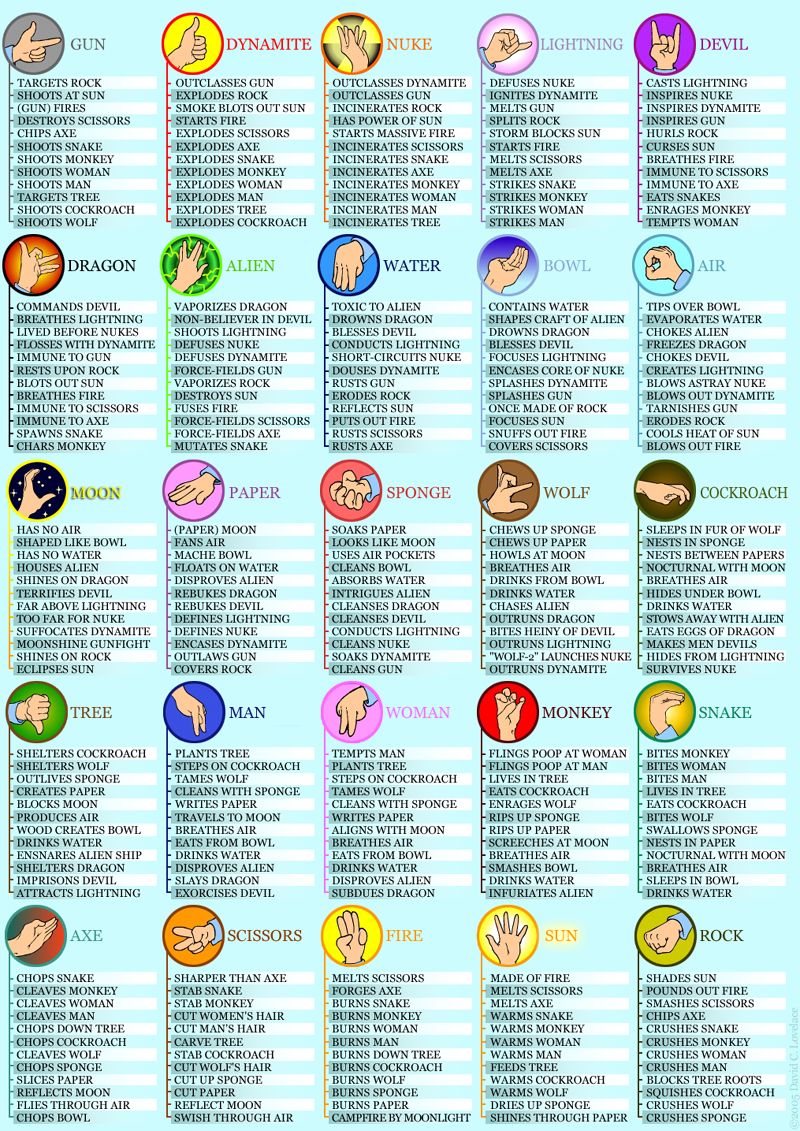
You know what really bothers me? When a major decision needs to be made and logic is just getting in the way. Introducing a new generation of the classic Rock/Paper/Scissors game.

No longer are you stuck with just rock, paper, or scissors, now there are 25 hand gestures to choose from to prove that your idea is the greatest. For instance, lightning melts scissors, devil inspires dynamite, and nuke incinerates monkey – fascinating. Click the link above to see how they all interact. Good luck figuring it out, I can't make dynamite or snakes out of it.

So there you have it. The next time you're unsure how to proceed with the strategic development of your client's or organization's communication tactics, here is a surefire way to make great decisions. It's time to show your boss that you, too, are management material.
(Thanks, Boing Boing)

Design a site like this with WordPress.com
Get started